

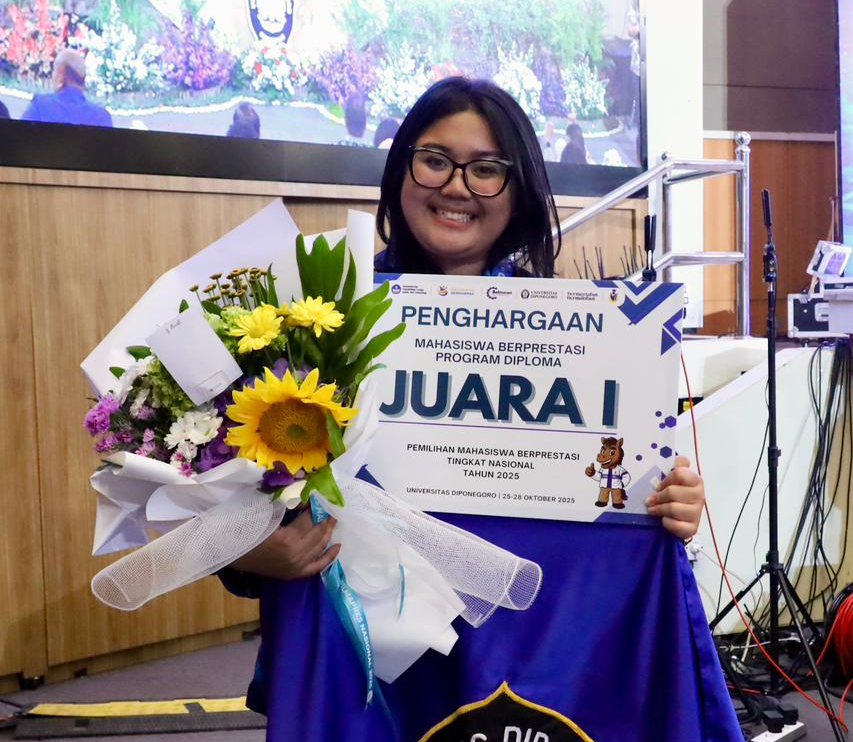
SEMARANG (17/04) — From being a nobody to becoming well-known, from once being rejected everywhere to now becoming a student who has achieved victory in a highly prestigious competition. To find out how her journey unfolded from the very beginning until she became a champion, the Research and Scientific Division of BEM UNDIP together with the Diponegoro University Student Achievement Office recently conducted an exclusive interview with Callysta Najmi Raissa, commonly known as Callysta. She is a student of Industrial Chemical Engineering Technology who successfully won 1st Place in the National Diploma PILMAPRES 2025 competition. Starting as someone who lacked exploration during high school, she later dared to try becoming a Master of Ceremony at a vocational event, and eventually became the champion.
Callysta’s journey to becoming the PILMAPRES champion was never something she had planned, and she herself never expected to make it that far. Once underestimated as a gap year student, she instead turned failure into a starting point to rise and grow. She began actively participating in various university activities until she was eventually recommended as a PILMAPRES delegate. Throughout the process, she did not set high expectations for herself and felt that the other participants were superior. However, her curiosity about the limits of her own abilities encouraged her to keep trying despite her fears. With support from her lecturers, Callysta managed to overcome her self-doubt and surpass limits she had never imagined before.
During the course of the PILMAPRES competition series, Callysta lacked confidence in the Outstanding Achievements (CU) assessment aspect that she possessed. Therefore, she chose to focus more on developing her talents in the Innovative Product (PI) assessment aspect. In addition to refining her Innovative Product, Callysta also improved her English-speaking skills. She paid attention to several judging aspects of the competition, including the way she spoke, interacted, and maintained her attitude while presenting in front of the judges. The principle she firmly held in her heart was “Show the real character,” where she emphasized that in competitions, we must present the best version of ourselves without pretending to be someone else and enjoy the entire process from beginning to end.
Callysta’s preparation for PILMAPRES lasted for approximately one full year. During that process, she also had to face a considerable academic workload, especially in her fifth semester, which she admitted was extremely demanding. She began to experience feelings of burnout. Whenever she felt overwhelmed, Callysta had her own ways of preventing burnout: getting enough sleep, tidying up her room, finding a new atmosphere outside her boarding house, and most importantly, sharing her thoughts with Feli, her friend as well as her teammate. Her time management strategy was also quite simple—making notes about where to start and realizing that time keeps moving forward. “No matter what, time passes very quickly. We have to be aware of it and know where to start,” she said.
Behind the journey she has gone through, there is one figure who has had the greatest influence on Callysta’s life: her father. Her father has always supported everything Callysta did, including when she first tried becoming an MC at a campus event—he was always there to encourage her. And it was through that experience that Callysta began to gain recognition and attention. One simple principle from her father that she still holds onto today is: “Don’t be selective about opportunities. Don’t underestimate small things, because those small things might be what make you great.” Her father’s character of boldly jumping into opportunities without overthinking, it seems, has also been passed down to Callysta.

According to Callysta, Indonesian society still tends to underestimate vocational education. In fact, an applied bachelor’s degree (D4) is equivalent to a bachelor’s degree (S1). The difference lies only in the curriculum delivered. Vocational education focuses more on practical work rather than theory. Furthermore, the facilities at Diponegoro University’s Vocational School are currently quite adequate. Many of its students also have experience in research or even in other fields. Callysta’s habit of conducting research was formed partly because she was accustomed to carrying out laboratory practicums during her studies, participating in lecturers’ projects, and joining competitions such as PKM.
At the end of the interview, Callysta shared a simple yet meaningful message. She reminded everyone that being able to attend university is already a privilege that not everyone has, and wasting that opportunity would be a great shame. Looking ahead, she herself has more structured plans: focusing on graduating and securing a job. It does not always have to be perfect, but it must be driven by determination. And for anyone who is still hesitant to take a step forward, Callysta has one message: “Just try, whatever it is, no matter how small or big the opportunity may be. If it turns out badly, it becomes a lesson; if it turns out well, it is also a lesson. Everyone has their own path. Don’t be afraid, stay motivated. Being tired is okay, just get back up again.” Callysta’s story of perseverance proves that we must dare to start something we have never tried before with sincere intentions from the heart, because in the end, it will lead to a rewarding outcome.